
October 8, 2026
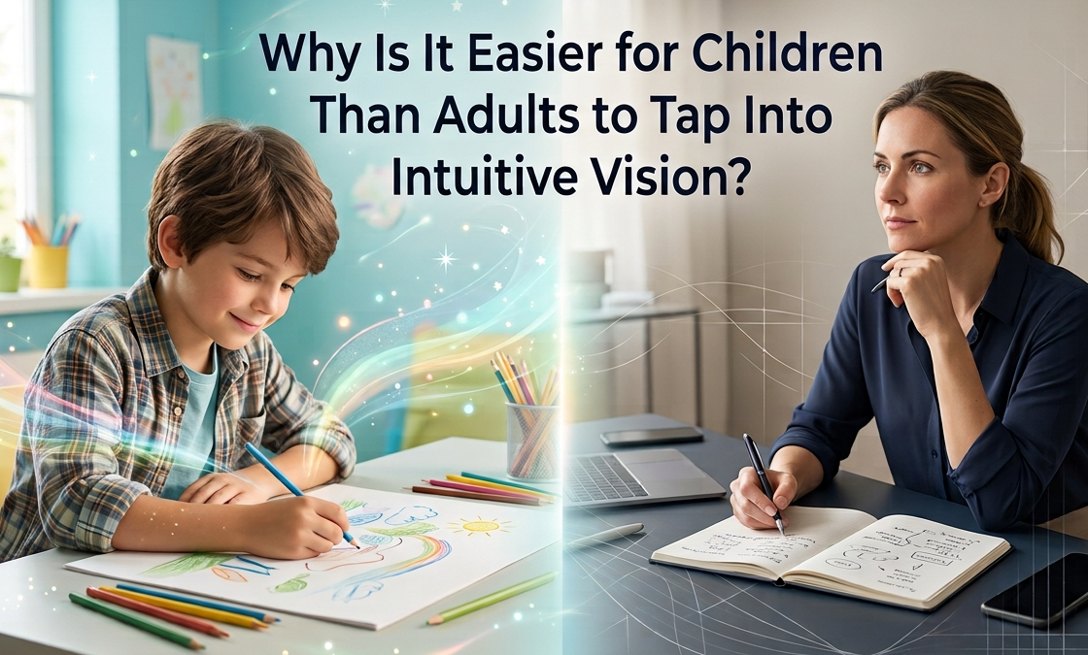
Why Is It Easier for Children Than Adults to Tap Into Intuitive Vision?
Have you ever noticed how children seem to know things without being able to explain why?
As adults, we often dismiss these moments as imagination, coincidence, or childish thinking. But what if there's something valuable about the way children experience the world that we gradually lose as we grow older?
When exploring intuitive vision, children often approach the experience with a level of openness that adults find difficult to access.
And there are some fascinating reasons why.
Children Haven't Learned to Doubt Everything Yet
One of the biggest differences between children and adults is the way they respond to the unknown.
When an adult experiences something unexpected, the analytical mind immediately steps in:
Is this real? Am I imagining it? What if I'm wrong? Does this even make sense?
Children, on the other hand, are often more willing to explore an experience without immediately questioning or judging it.
They haven't accumulated the same years of conditioning, skepticism, and fear of making mistakes.
This doesn't mean children are always more accurate in their perceptions. It means they may be more comfortable experimenting without needing an immediate explanation.
Sometimes, the biggest obstacle to exploring intuition isn't a lack of ability. It's the fear of being wrong.
Their Imagination Is Still Wide Open
Children naturally move between imagination, creativity, and reality throughout their day.
They can turn a cardboard box into a spaceship, create entire imaginary worlds, and visualize possibilities that adults might never consider.
This ability to imagine freely can make children particularly receptive to exercises involving mental imagery, visualization, and intuitive exploration.
In intuitive vision practices, participants may be encouraged to notice impressions, colors, shapes, or images that arise in their minds.
Children often approach these exercises playfully, without worrying about whether they're doing them correctly.
While imagination and intuitive perception aren't the same thing, the freedom to explore mental imagery can make the learning experience feel much more natural.
Adults Have Been Conditioned to Rely on Logic
From an early age, we're taught to prioritize facts, explanations, and measurable results.
And for good reason. Critical thinking is essential.
But somewhere along the way, many adults begin to believe that if something cannot immediately be explained logically, it isn't worth exploring.
We become accustomed to analyzing every decision, questioning every impression, and searching for external validation.
Children haven't necessarily developed these habits to the same degree.
They may find it easier to notice their initial impressions before trying to interpret them.
The goal isn't to replace logic with intuition.
It's to recognize that intuition and critical thinking can work together.
Children Are Often More Present in the Moment
Think about how much time adults spend mentally living in the past or future.
We're thinking about work, responsibilities, conversations, finances, and everything we need to accomplish tomorrow.
Our minds are constantly busy.
Children, particularly younger ones, often become completely absorbed in whatever they're doing.
When they're playing, drawing, or exploring something that interests them, their attention can be focused on sensations, impressions, and internal experiences.
It's not that children never get distracted. They certainly do.
But they can often enter a state of playful concentration without the same pressure adults place on themselves.
Children Naturally Trust Their Inner Experiences
Before children learn to seek constant approval from others, they often express their feelings quite directly.
They tell us when they're uncomfortable, when something excites them, or when they don't want to do something.
As we grow older, social expectations can teach us to override those internal signals.
We begin to wonder what other people will think.
We question ourselves.
We sometimes ignore our own feelings because they don't seem logical or convenient.
Helping children develop a healthy relationship with their intuition can mean teaching them to recognize their emotions, listen to their bodies, ask questions, and communicate their experiences confidently.
Importantly, trusting an inner feeling doesn't mean assuming it's always correct. Learning to distinguish feelings from facts is part of developing good judgment.
So, Can Adults Learn to Access Intuitive Vision Too?
Absolutely, adults can explore intuition, visualization, and awareness practices.
In fact, adults bring valuable strengths to the experience, including patience, reflection, and the ability to evaluate their impressions critically.
The challenge is often allowing themselves to become beginners again.
To experiment without expectations.
To be curious without immediately demanding answers.
To rediscover the kind of playful openness that comes so naturally to many children.
Curious what a class feels like?
Book a free 15 minute discovery call and I will answer all your questions.
Book my free discovery call